What is a Shaker Kitchen? A Complete Guide to the popular style of cabinets
Kitchen

When you’re planning your new kitchen, the sheer number of choices in bespoke design can seem overwhelming. Layout, materials, colours and appliances all play their part, but the style of your kitchen cabinets perhaps has the greatest influence on the character of the finished room.
One such style has remained particularly enduring: the Shaker.
This guide details exactly what a shaker kitchen is from top to bottom, illustrating the distinction between simple shaker and shaker style designs, and why after all this time, the Shaker design continues to work across homes of all different styles and eras.
Quick Answer: What is a Shaker Kitchen?
Strictly speaking, it’s all about the cabinet door. A shaker kitchen is built around a five-piece cabinet door consisting of two vertical stiles, two horizontal rails and a flat recessed centre panel. The name descends from the furniture traditions of the Shaker movement, a religious sect favouring simplicity and minimalism.
It’s this simplicity that gives a Shaker kitchen such versatility, and why since 1994, at Chamber Furniture we’ve made more shaker kitchens than any other kind.
Here’s a photo of a traditional Shaker kitchen:

The History behind Shaker Style Kitchens – a deeper dive
As aforementioned, the style dates back to a religious group originating in 1774, called the Shakers, who shunned materialism and enjoyed living simply with minimalist surroundings. In line with their ‘principles of honesty and utility,’ the ‘shaker community later became known for producing their own furniture… with their approach to craft reflecting their wider [morals] of simplicity.’ (2)
Excessive ornamentation was therefore rejected in favour of form, proportion and practicality. Likewise, the materials used originally were what was locally available in America, ‘including pine and maple, with pieces often painted or stained.’ (2)
https://www.metmuseum.org/essays/shaker-furniture
While the kitchens we design today, of course, have advanced, the logic behind the furniture has remained remarkably relevant: simple forms made well, with function at the forefront.

Shaker vs Traditional: What’s the difference?
What Shaker is not, is a synonym for a ‘traditional’ kitchen.
A kitchen can be framed, panelled and ornate without being strictly Shaker. The style’s character lies in its simplicity, and once more decorative mouldings are introduced, the design seems to move away from a classic Shaker door into a Shaker style design.
This matters when comparing like for like. Shaker-style describes a broad spectrum of cabinetry, but when you look at how the door is made up, the answer tells you what you’re buying.
While many traditional kitchens can be Shaker-style, it’s the decorative details that can steer the cabinetry away from a simple Shaker status.
This is best shown through comparing two of our projects: One a shaker-style kitchen (deviating from the simple five door make up) and the other a faithful representation.
Project 7152 – A Shaker-style Kitchen

Here is our oak and granite Shaker-style Kitchen, featuring oversized cabinetry scaled and proportioned to the space. While this strikes the balance of beauty and restraint as a shaker kitchen typically does, when we take a closer look, the mouldings are more advanced, rendering it more complex than simple shaker alone.


This type of moulding is called lambs tongue detail, a popular choice among our clients, and a great way to illustrate how bespoke design comes into its own when choosing a Shaker-style Kitchen. At Chamber Furniture, our designers work with your tastes and have the flexibility to add as many mouldings, details or intricacies as you wish, or none at all!
In our Kent showroom, our material library showcases the full range, allowing clients to talk through their likes and dislikes with their designer to form their desired space. This communication is essential in the planning stage, as we have complete design flexibility to cater to any specification.
Here, you’ll see how the pale shade of Farrow & Ball’s Skimming Stone No.241, has been paired with 80mm Negresco Granite worktops: a bold worktop to add definition, while allowing the calmer colours to pervade. It’s a great example of how we pair materials accordingly, and illustrates how you can have a combination of colours, materials and finishes all running alongside each other.
Moreover, it’s important to note that what might look right on your main kitchen run, may not be the obvious choice inside your pantry. And that’s ok! Here, our clients opted for a more pared back cabinetry design to avoid the space appearing too busy against their spice racks, moving away from shaker entirely and instead opting for an in-frame traditional style drawer as the pantry is hidden behind retractable doors.


Likewise, the central island is finished in stained oak, sitting between the lighter shade of the main run and the dark granite worktops, while complementing the tone of the brass handles.
In summary, this is not just a straightforward Shaker kitchen, it comes under the broader umbrella of a Shaker-style kitchen, due to its more ornate detailing.

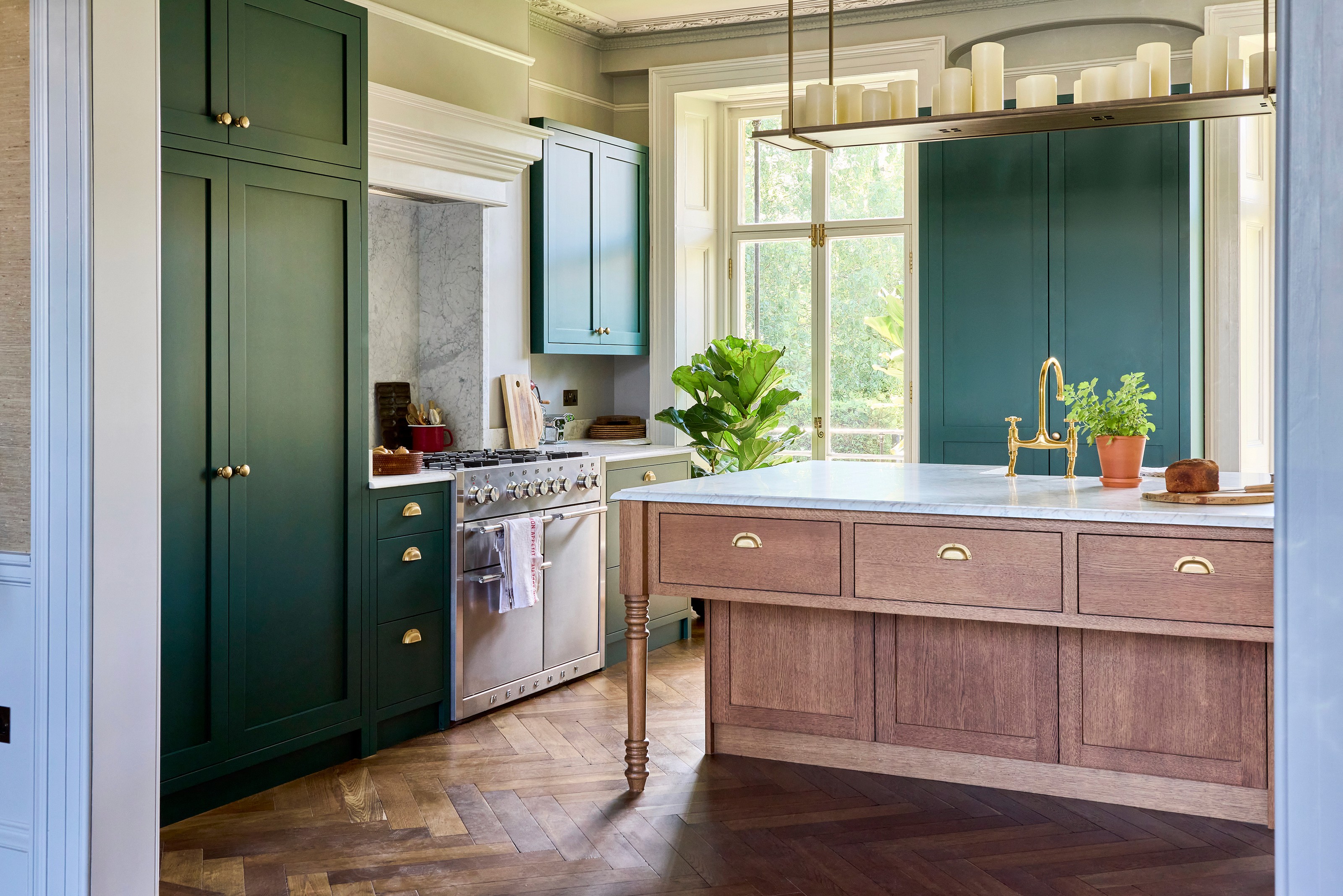
Project 8076 – A Faithful Shaker Kitchen
Set within the walls of a Grade II listed Sandstone villa, this kitchen remains faithful to the Shaker make-up. It's evident in its framed construction and simple proportions.
However, it’s the finer details here that give the kitchen its character, demonstrating the pure joy of bespoke design. The island has been distressed and wire-brushed in a dark oak stain with a 10% sheen. Honed Carrara marble worktops with a bullnose edge and a full marble upstand carry the run, while aged brass knobs and cup handles pick up the warmth of the oak.
This design responds perfectly suits the homeowner’s demands, while being an elegant use of space and complementing the building’s architecture that we were so fortunate to inherit.
While this is a simple shaker kitchen, there is certainly no compromise in the level of technicality. Rather, it’s the minor details that elevate this design, and make the Chamber difference: the raised and fielded centre panels set in reverse, the dovetailed drawer boxes, the chamfered frames, and of course it goes without saying that it’s completely unique.
Why are Shaker Kitchens so Popular?
They’re Versatile:
They form a starting point from which your bespoke kitchen can then blossom. Start with a simple shaker door, and there is freedom from there on. Colour, worktops, handles, stone and the proportions of the cabinetry all alter how the finished space comes into its own. When designing bespoke, this is particularly important as it widens the conversation.
Shaker kitchens can also be paired with all types of architecture, flattering a listed cottage and a glass extension alike, which very few styles manage to achieve.
They’re Calm:
Their minimalist nature adds calm to a room, separating them from ornate styles which some might find too fussy.
They’re Durable:
The construction that made sense in the 1800s still makes sense in a busy family kitchen today, and a well-made frame keeps its geometry for decades.
Their Longevity:
They have the ability to be re-painted year on year, allowing clients to refresh their cabinetry if they tire of a colour palette.

What Materials are Shaker Cabinets Made from?
For an unpainted finish, we typically recommend solid oak. However, for painted, tulipwood or maple are the classic choice. They’re stable under paint, crisp in the frame, with oak where the grain itself is wanted, and quarter cut where straightness of figure matters.
Choosing Shaker Cabinet Handles
Historically, handles were typically made from the same wood as the cabinet to embody minimalist principles. However, designs today typically favour chrome, steel, or brass pulls to add interest or detail to a modern, simple look. There’s no right or wrong, it’s purely down to personal preference and the wider design vision.
So, what makes a Chamber Furniture Shaker Kitchen different?
As well as the quality of our craft, what really sets us apart is our in-house approach to bespoke design, allowing your furniture to be finished to any specification you decide. This goes for combining a variety of colours, materials, sheens, handles, and of course we can mix styles of kitchens – creating entirely hybrid designs which have both handleless elements running alongside the more traditional.
Just because shaker designs are typically more widely sought after, and can be bought elsewhere in custom ranges and standard sizing, with us, there is no compromise on the bespoke nature of your commission.
For us, Shaker describes a design direction not a range.

Summing up:
Traditional Shaker, more ornate, contemporary or neither?
As our own projects demonstrate, the five-piece door construction is only the starting point. Some kitchens remain faithful to simple shaker principles; others borrow from them, combining different mouldings to create something more individual.
Most of our commissions deliberately lie somewhere in between.
The honest truth is that Shaker is not always right. In a sleek city apartment, a handleless kitchen usually serves better; yet in a house with strong mid-century bones, the slab and timber language fits the architecture.
We will make those recommendations during the design stage because, ultimately, a kitchen should belong to its home and the people living within in, rather than adhere to a particular search trend.
To show you the versatility of the shaker-style, here are some examples of our craft:


Every Chamber Furniture project begins with a conversation.
If you are considering a bespoke project that seamlessly unites craftsmanship, heritage, and your unique vision, get in touch today. Our team would be delighted to discuss how we can bring your ideas to life with precision and artistry.

Questions about this topic